Japan vs Nigeria: Flamingos chase history as Africa's first U-17 Women's World Cup title beckons | Preview, Predicted XI, Key Players and How to Watch Live
Nigeria's five-match winning run has taken them to their first FIFA U-17 Women's World Cup final. But standing in their way is a Japanese side with a rich history at this level and ambitions of reclaiming the title.


One match stands between Nigeria's Flamingos and a place in history.
After an opening defeat to Poland, five consecutive victories have taken Akeem Busari's side to their first FIFA U-17 Women's World Cup final. They have overcome established opponents, produced important individual performances and demonstrated the character required to survive the pressure of knockout football.
Now, they face Japan. The Japanese are no strangers to this stage. They have appeared in three previous finals, winning the competition in 2014 and finishing runners-up in 2010 and 2016. They return to the final after a ten-year absence, determined to add another title to their history.
For Nigeria, however, the opportunity is even more significant. No African nation has ever won the FIFA U-17 Women's World Cup. Victory would make the Flamingos the first African champions and give the continent a new landmark in women's football.
It is a final between a team seeking its first title and a former champion hoping to reclaim the crown.
Nigeria: Five consecutive wins after an opening setback
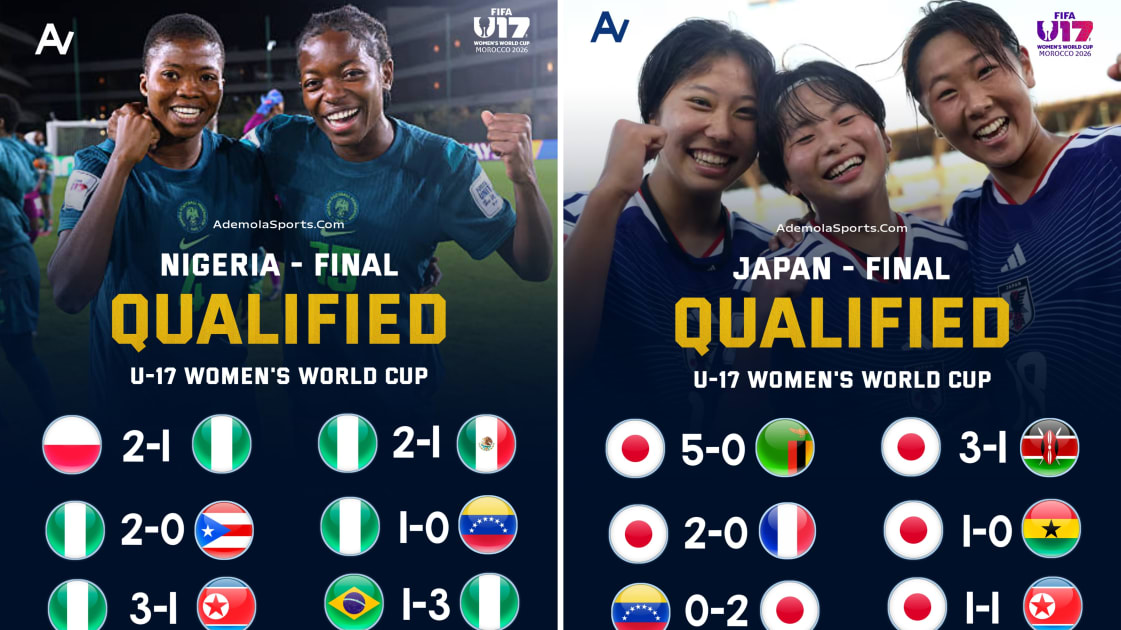
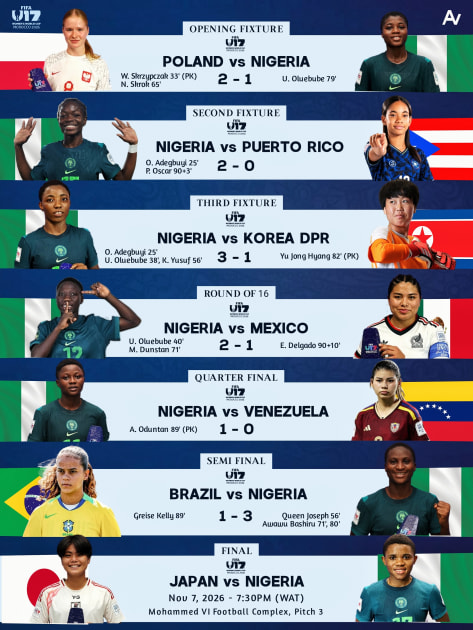
Nigeria's campaign did not begin as planned. The Flamingos lost 2-1 to Poland in their opening Group B match, leaving themselves with little room for further mistakes. Their response was emphatic.
They defeated Puerto Rico 2-0, with Oluwakemi Adegbuyi and Precious Oscar scoring, before producing one of their strongest group-stage performances against DPR Korea.
Goals from Adegbuyi, Oluebube Umejiaku and Kanyinsola Yusuf secured a 3-1 victory over the four-time champions. It was an important statement of Nigeria's attacking quality and ability to compete against technically accomplished opposition.
The Flamingos continued their progress in the knockout rounds, defeating Mexico 2-1 in the Round of 16. Umejiaku and Mary Dunstan scored to take Nigeria into the quarter-finals.
Against Venezuela, the breakthrough came late. After a difficult contest, Umejiaku was fouled in the penalty area, allowing captain Azeezat Oduntan to convert an 89th-minute penalty and secure a 1-0 victory.
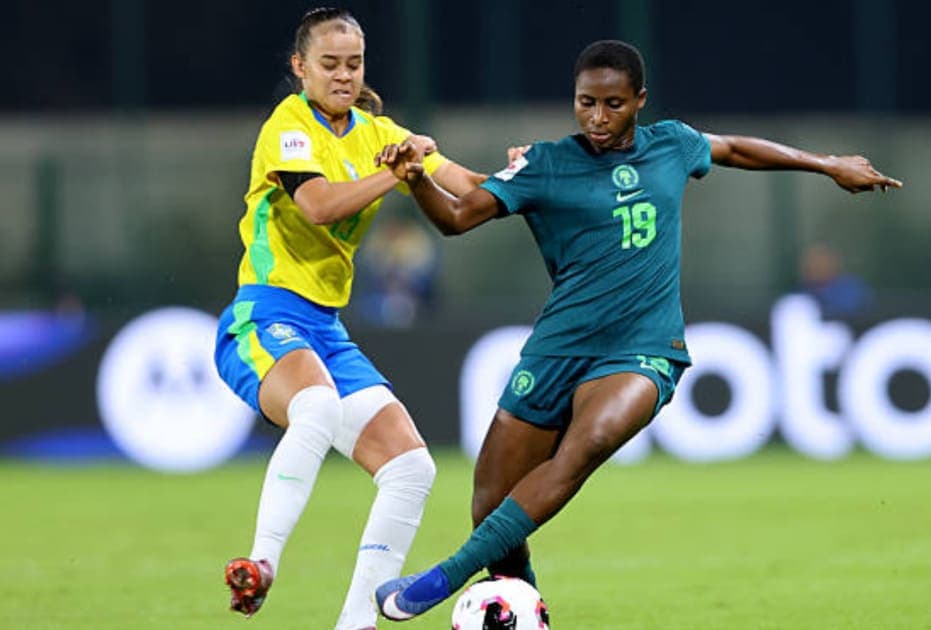
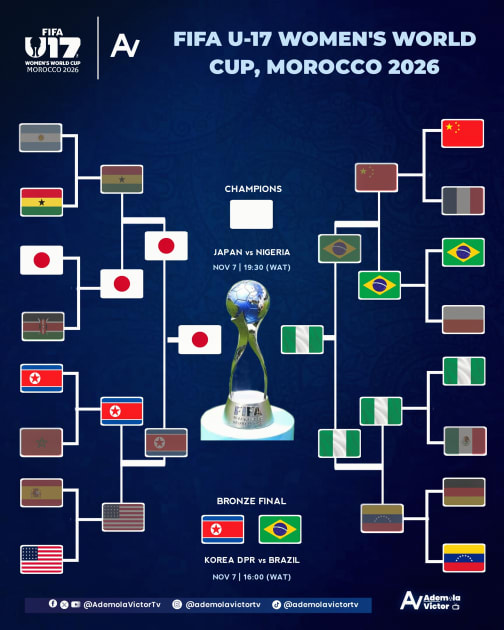
Brazil provided the opposition in the semi-final, and Nigeria produced arguably their most commanding performance of the competition.
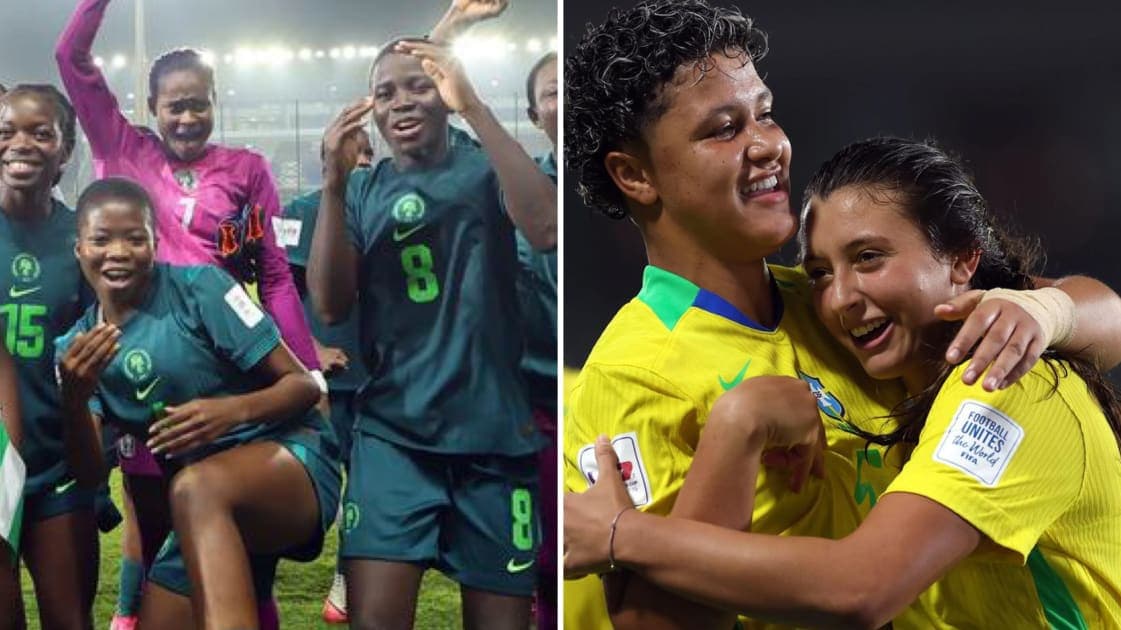
After a goalless first half, Queen Joseph opened the scoring in the 56th minute. Awawu Bashiru then scored twice, in the 71st and 80th minutes, to put Nigeria in control. Greise Kelly scored a late consolation for Brazil, but the Flamingos had already done enough to secure a 3-1 victory.
FIFA recorded 35 shots for Nigeria compared with Brazil's seven, while the South Americans managed only one effort on target.
The result confirmed Nigeria's place in their first-ever U-17 Women's World Cup final.
Since losing to Poland, the Flamingos have won five consecutive matches, scoring 11 goals and conceding three during that winning run.
Japan: A former champion returns to the final
Japan have taken a different route to the final, building their campaign around technical quality, organisation and attacking efficiency.
Under coach Sadayoshi Shirai, they began with a 5-0 victory over Zambia before defeating France 2-0 and Venezuela by the same scoreline. They finished the group stage with three victories and no goals conceded.
Their knockout campaign continued with a 3-1 win over Kenya and a narrow 1-0 victory against Ghana.
The semi-final against DPR Korea was their biggest examination.
Japan had lost 5-1 to DPR Korea in the 2025 U-17 Women's World Cup quarter-finals and suffered the same scoreline in the 2026 AFC U-17 Women's Asian Cup final. The semi-final therefore offered an opportunity to overcome a difficult recent history against their Asian rivals.
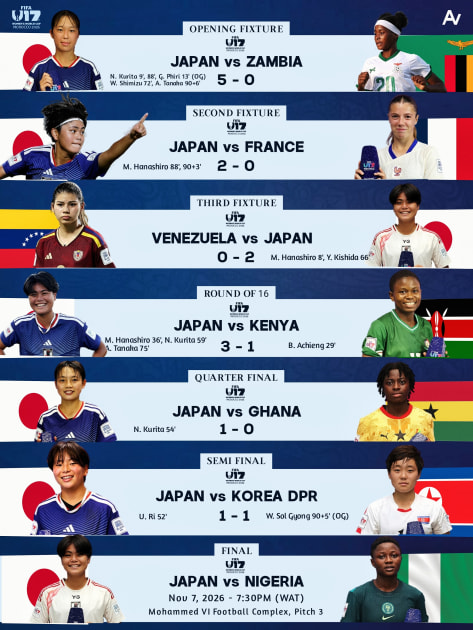
DPR Korea appeared close to another victory after Ri Ui-gyong scored in the 52nd minute. Japan struggled to create clear opportunities, recording just four shots, with only one on target.
But they refused to give up.
A late own goal by Won Sol-gyong in the 90+5th minute took the match to penalties. Japan converted all four of their attempts, while goalkeeper Kou Kadowaki saved one DPR Korea effort and another struck the post.
Asuka Tanaka converted the decisive penalty to secure Japan's return to the final.
The victory demonstrated that Japan can find a way through difficult circumstances, even when their attacking game is not functioning at its best.
No previous meeting at the U-17 Women's World Cup
Saturday's final will also be the first meeting between Nigeria and Japan at the FIFA U-17 Women's World Cup. There is no previous head-to-head record between the countries at this competition to provide a direct reference point. At youth level, different generations bring different players, coaches and circumstances. This final will be decided by the current squads, their preparation and their ability to perform under pressure.
The tactical contest: Can Nigeria disrupt Japan's rhythm?
The midfield battle could have a significant influence on the final.
Nigeria have shown attacking variety, movement and an ability to find goals through different players. Their performance against Brazil in the semi-final, when they registered 35 shots and scored three goals, demonstrated their attacking threat and ability to put opponents under sustained pressure.
Japan, meanwhile, have built their campaign around technical combinations, possession and coordinated movement. Their ability to build attacks from the back and involve their full-backs in forward play makes them a difficult opponent to contain.
Busari has already offered an insight into his assessment of Japan. Speaking after the semi-final victory over Brazil, the Nigerian coach identified similarities between Japan and DPR Korea, particularly their preference for building from the back, using passing combinations and allowing full-backs to support attacks.
He believes Nigeria can draw on their 3–1 group-stage victory over DPR Korea as a reference point. However, Japan have their own qualities and should not be treated as a replica of their Asian neighbours.
Nigeria will need to disrupt Japan's passing rhythm without losing their defensive organisation. Pressing at the right moments could force mistakes, but poorly coordinated pressure could leave spaces for Japan to exploit. The Flamingos must also be prepared to manage periods without the ball.
For Japan, the challenge will be to control possession, limit Nigeria's forward movement and prevent the Flamingos from creating dangerous situations around their penalty area.
Ultimately, the effectiveness of both teams in midfield, their ability to manage transitions and the decisions they make in the final third could prove decisive in determining who lifts the trophy.
Players to watch
Nigeria
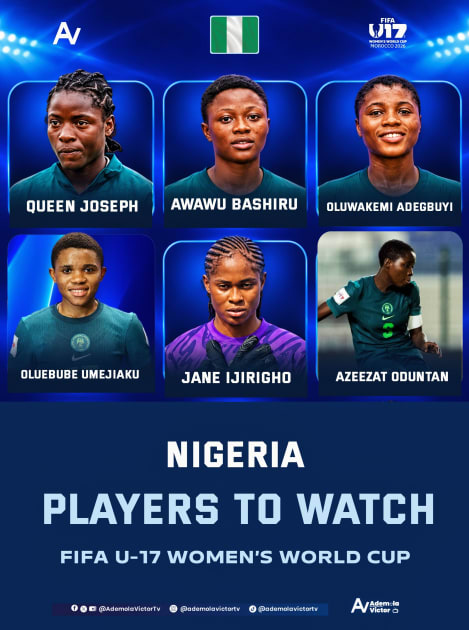
Queen Joseph: Joseph will be one of Nigeria's attacking players to watch after opening the scoring against Brazil in the semi-final. Her ability to find space and contribute in important moments gives Busari another attacking option. She will be hoping to make a similar impact in the final.
Awawu Bashiru: Bashiru enters the final after scoring twice against Brazil and receiving the Player of the Match award. She replaced the slightly injured Tosin Rafiu in the semi-final starting line-up, making her first start of the tournament. Her performance gave Busari another attacking option and could strengthen her case for a place in the final XI.
Oluebube Umejiaku: With three goals in the tournament, Umejiaku has been one of Nigeria's most influential attacking players. She also provided an assist against Puerto Rico and won the penalty that decided the quarter-final against Venezuela. Her movement and ability to attack spaces behind defenders will be important against Japan.
Oluwakemi Adegbuyi: Adegbuyi has scored twice in the tournament and contributed to Nigeria's attacking combinations. Her involvement in the build-up to Joseph's goal against Brazil demonstrated her ability to create opportunities for teammates as well as finish them herself.
Azeezat Oduntan: The Nigerian captain will have an important responsibility in organising the defence. Her leadership and defensive discipline will be particularly important against a Japanese team that has scored 14 goals in the competition.
Jane Ijirigho: Nigeria's goalkeeper will need to remain alert against Japan's movement and technical quality. Her ability to make important saves and organise the defence could be crucial.
FIVE FLAMINGOS, FIVE PLAYER OF THE MATCH AWARDS.

For the first time at a FIFA tournament, five different Nigerian players have won the Player of the Match award across six matches at a single edition of the FIFA U-17 Women’s World Cup.
They are;
🇳🇬 Oluwakemi Adegbuyi (Robo Queens) - vs Puerto Rico
🇳🇬 Kanyinsola Yusuf (Robo Queens) - vs Korea DPR
🇳🇬 Oluebube Umejiaku (Heartland Queens) - vs Mexico
🇳🇬 Favour Nkwocha (Robo Queens) - vs Venezuela
🇳🇬 Awawu Bashiru (Confluence Queens) - vs Brazil
Japan
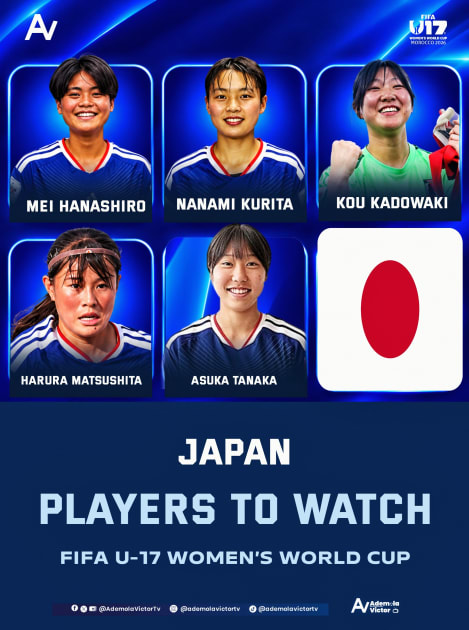
Nanami Kurita: Kurita has been one of Japan's leading attacking threats, scoring four goals in the tournament, including the winning goal against Ghana in the quarter-finals. Her movement and finishing make her a player Nigeria must monitor closely.
Mei Hanashiro: Hanashiro has also been an important contributor to Japan's attacking campaign. Her movement, ability to find scoring positions and threat around the penalty area could test Nigeria's defensive concentration.
Harura Matsushita: FIFA identified Matsushita as Japan's player to watch before the tournament. The defensive midfielder is composed on the ball and reads the game well, helping to break up opposition attacks. Her influence could be especially important in the midfield battle against Nigeria.
Kou Kadowaki: Kadowaki played a decisive role in Japan's semi-final victory, saving a penalty against DPR Korea. Her confidence will be high, and Nigeria will need to test her with purposeful attempts.
Asuka Tanaka: Tanaka came off the bench against DPR Korea and converted the decisive penalty. Her contribution demonstrates the options Japan have available when they need to change a game. She could again be an important player, whether starting or coming on during the final.
The historical record: Japan's experience versus Nigeria's opportunity
Although this is the first meeting between the countries at the competition, their histories at the FIFA U-17 Women's World Cup are considerably different.
Japan have been one of the established nations in the tournament since its inaugural edition in 2008. They have reached the final four times, including this year's edition, and have previously lifted the trophy.
Nigeria have also been regular participants, but their best result before Morocco 2026 was a third-place finish in India in 2022.
JAPAN VS NIGERIA: HISTORICAL COMPARISON
Tournament appearances: 🇯🇵 10 | 🇳🇬 9
Previous titles: 🇯🇵 1 (2014) | 🇳🇬 0
Previous final appearances: 🇯🇵 3 | 🇳🇬 0
Runners-up finishes: 🇯🇵 2 (2010, 2016) | 🇳🇬 0
Third-place finishes: 🇯🇵 0 | 🇳🇬 1 (2022)
Best previous finish: 🇯🇵 Champions (2014) | 🇳🇬 Third place (2022)
2026 achievement: 🇯🇵 Return to the final after 10 years | 🇳🇬 First-ever final
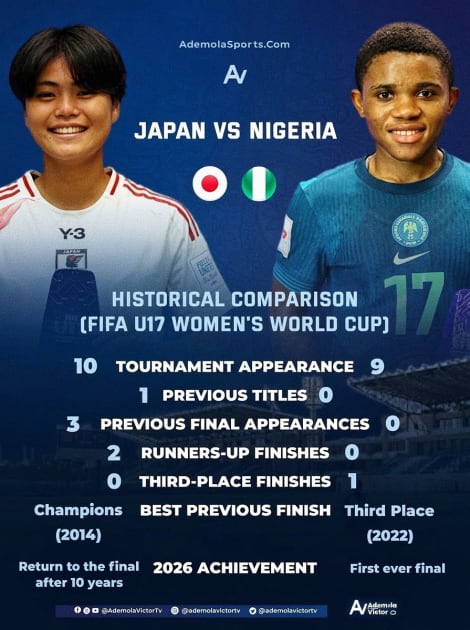
Japan's history includes two runners-up finishes in 2010 and 2016 before their 2014 triumph. They have also reached the quarter-finals on several occasions, demonstrating their consistency at this level. Nigeria's previous best was the bronze medal in 2022. They reached the quarter-finals in 2024 but exited in the Round of 16 in 2025.
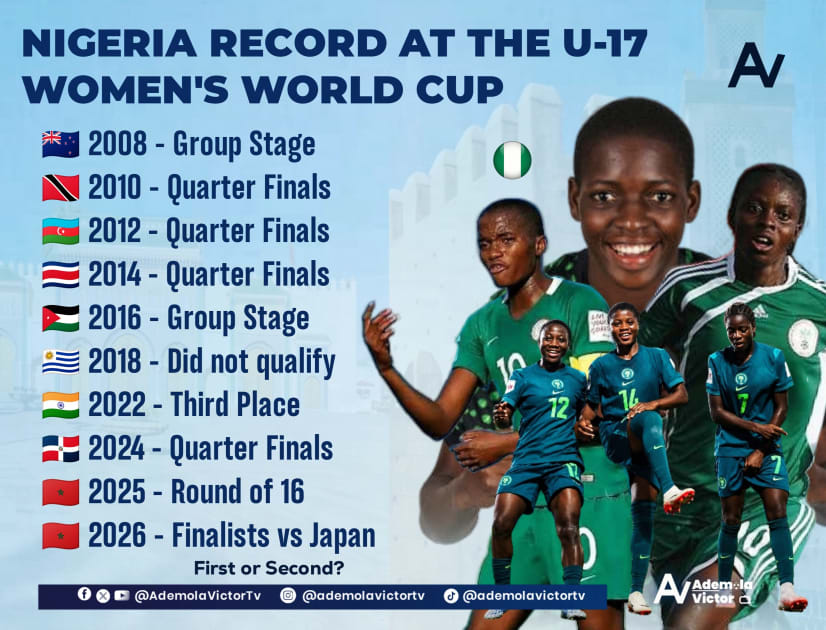
The 2026 campaign has therefore already delivered Nigeria's best-ever performance at the competition.
The contrast is clear: Japan are pursuing another title to add to an established record, while Nigeria are trying to achieve something their country and the entire African continent have never accomplished.
What the numbers tell us
Both teams have scored freely, but their defensive records reveal an important difference.
JAPAN VS NIGERIA: TOURNAMENT STATISTICS
Matches played: 🇳🇬 6 | 🇯🇵 6
Wins in normal time: 🇳🇬 5 | 🇯🇵 5
Draws in normal time: 🇳🇬 0 | 🇯🇵 1
Defeats in normal time: 🇳🇬 1 | 🇯🇵 0
Goals scored: 🇳🇬 12 | 🇯🇵 14
Goals conceded: 🇳🇬 5 | 🇯🇵 2
Clean sheets: 🇳🇬 2 | 🇯🇵 4
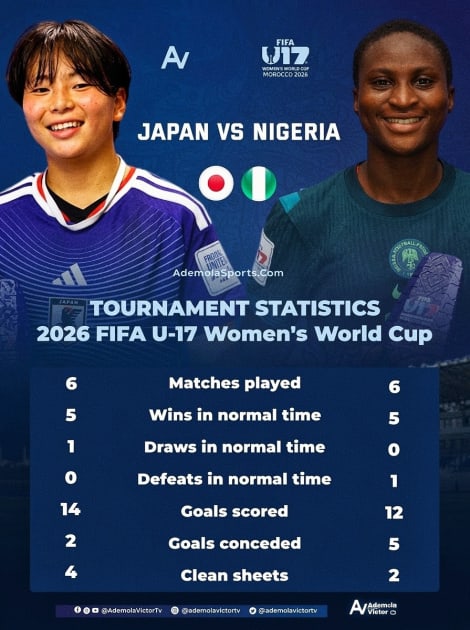
Japan have scored two more goals than Nigeria and conceded three fewer. Their defensive organisation has been one of the foundations of their campaign.
Nigeria, however, have demonstrated considerable attacking variety, with eight different goalscorers contributing to their 12 goals. Seven of Nigeria's goals have come in the second half, showing their ability to remain dangerous as matches progress.
The statistics suggest Japan have been more difficult to break down, while Nigeria have shown an ability to produce decisive attacking moments. Neither record guarantees anything in a final.
The coaches and the final challenge
For Busari, the challenge is to prepare a team that has already overcome several different opponents for its biggest match yet.
His assessment of Japan suggests that Nigeria will pay close attention to their build-up play and the movement of their full-backs. But the Flamingos must also preserve the attacking confidence that has taken them this far.
The coach will have decisions to make around the starting line-up, including whether Bashiru retains her place after her outstanding semi-final performance.
For Shirai, the task is to prepare Japan for a Nigerian team that can be direct, physical and dangerous in the final third.
Japan's semi-final showed that they can survive a difficult match, but they will need to be more effective in possession and create more clear-cut opportunities than they managed against DPR Korea.
Both coaches have demonstrated an ability to make important decisions during the tournament. Their choices on Saturday could prove decisive.
What is at stake?
For Japan, victory would mean a second FIFA U-17 Women's World Cup title, 12 years after their first triumph in Costa Rica in 2014.
For Nigeria, the opportunity is historic.
No African nation has won the FIFA U-17 Women's World Cup. The Flamingos have already become the first African team to reach the final, and victory would take Nigerian and African women's football into entirely new territory.
Queen Joseph captured the significance of the occasion after the semi-final, explaining that Nigeria were not simply representing their country but Africa as a whole.
That responsibility will be shared by the entire squad, but the players must also remember that they have earned their place in this final.
They have recovered from an opening defeat, defeated DPR Korea, eliminated Mexico and Venezuela, and beaten Brazil convincingly.
They have earned the right to compete for the trophy.
The verdict: One more performance to make history
Japan's defensive record makes them a formidable opponent. They are technically accomplished, disciplined and experienced in handling difficult moments. Their victory over DPR Korea also demonstrated their resilience.
Nigeria, however, have momentum and an attacking threat that should not be underestimated.
The Flamingos will need to be patient, disciplined and clinical. They cannot afford to give Japan easy possession in dangerous areas, but they must also be brave enough to attack when opportunities arise.
The midfield battle, the effectiveness of Nigeria's forwards and the ability of both coaches to make timely adjustments could determine the outcome.
There is also the possibility that the final will require extra time or penalties. Japan have already demonstrated their composure in a shootout, while Nigeria's quarter-final victory over Venezuela showed they can handle late pressure.
This is a meeting of two teams with different histories, different journeys and the same ambition.
Japan want to reclaim the title they last won in 2014.
Nigeria want to win it for the first time and bring Africa its first crown.
The Flamingos have already made history in Morocco. Now they have one more opportunity to make it unforgettable.
The mission is no longer just to reach the final. It is to win it.

How to Watch Brazil vs Nigeria U17 Live
The FIFA U-17 Women's World Cup semi-final between Japan and Nigeria will take place on Saturday, 7 November 2026.
Kick-off: 6:30 pm Moroccan time (7:30 pm Nigerian time).
Fans can check the official FIFA+ platform for live scores updates. For live streaming check DAZN available in selected regions.
The match would be beamed live on NTA, AfroSport, M4STv and all other BON Partner Stations across the country.
Follow the Victor Ademola WhatsApp channel and AdemolaSports for updates, match coverage and reports from the FIFA U-17 Women's World Cup Morocco 2026.
MATCH INFORMATION
Fixture: Japan U-17 vs Nigeria U-17
Kick-off: 6:30 pm Morocco time / 7:30 pm Nigeria time
Date: Saturday, 7 November 2026
Venue: Mohammed VI Football Complex - Pitch 3, Rabat, Morocco
Competition: FIFA U-17 Women's World Cup Morocco 2026 Final
Enjoyed this story?
Reporting like this is funded by readers. A one-off gift keeps it coming.