
SUPER FALCONS BITE BACK: Nigeria’s Gritty 1-0 Win Over Zambia Puts Qualification in Their Own Hands - Full Madugu & Häuptle Press Conference + Players Reaction
Ten Women, One Goal, Three Points: How Nigeria Turned Adversity Into Control of Their Own WAFCON and World Cup Destiny

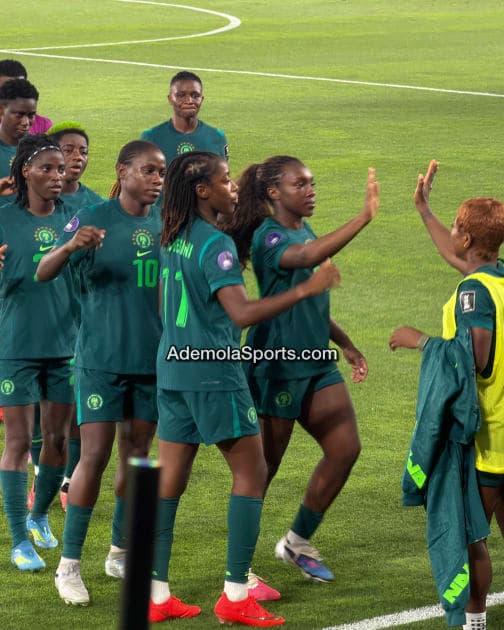
Few hours after the final whistle at Al Madina Stadium, Rabat, Nigeria's 1-0 win over Zambia is still the story dominating conversation in Group C of the 2026 Women's Africa Cup of Nations. It was not just a scoreline. It was a response, a statement, and for large parts of the second half, a survival mission that the Super Falcons pulled off with ten women on the pitch..
Asisat Oshoala settled it inside eight minutes, and from there Nigeria spent the remaining 82 minutes, plus a red card in the 40th minute, defending a lead that had to hold if the defending champions were to keep their title defence alive. It did hold. And now, courtesy of that head-to-head result, Nigeria sit second in Group C above Zambia on identical points.
THE MATCH IN CONTEXT
This was a different Nigeria from the one that lost 3-2 to debutants Malawi in the opener. Coach Justin Madugu made changes to his starting eleven, most notably starting Oshoala from kickoff and leaving out Esther Okoronkwo, a call that drew instant criticism on social media before kickoff even from fans who felt the coach was tinkering with a misfiring team. Eight minutes later, that selection had a hand in the goal that won the match. Oshoala did what Oshoala does, finishing off an early Nigerian chance to silence the doubters before some of them had even finished typing.
The game turned again just before half time. Oluwatosin Demehin was sent off in the 40th minute, leaving Nigeria to play the last 50 minutes plus stoppage time a woman short. Rather than retreat into their own box, Madugu's side chose control over panic. Christy Ucheibe, already comfortable playing as a holding midfielder for the Super Falcons, despite being a natural central defender, dropped into the back line without Nigeria needing to make a defensive substitution. It was a tactical solution built on the versatility Madugu had been talking about publicly even before the sending off.
Nigeria made some vital changes, working through the substitutions calmly: Shukurat Oladipo on for Rofiat Imuran in the 50th minute, a double change just after the hour mark that brought on Halimatu Ayinde and Chinwendu Ihezuo for Deborah Abiodun and Oshoala, and Esther Okoronkwo, the very player dropped from the XI, introduced in the 81st minute for Uchenna Kanu. The final whistle confirmed a first clean sheet of the tournament and three points that Nigeria could not afford to leave in Rabat.
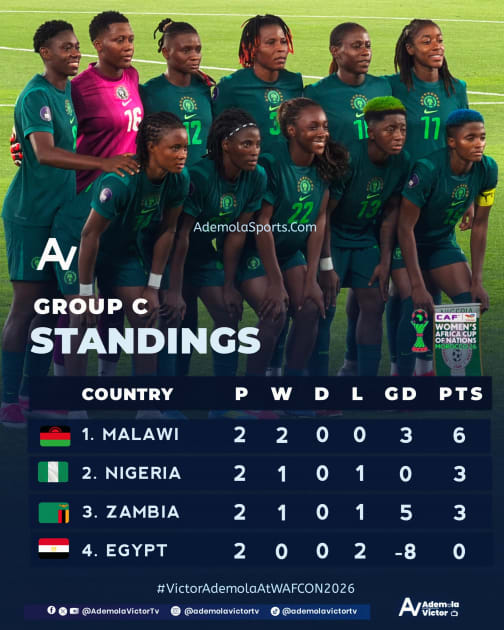
Group C Standings After Matchday 2 (as of 1 August 2026)
Malawi – 6 pts
Nigeria – 3 pts
Zambia – 3 pts
Egypt – 0 pts
Nigeria and Zambia are level on points, level on wins and losses, but Nigeria hold the tiebreak by virtue of beating Zambia head to head. That single result is currently the difference between the first, second place and third in a group where only the top two advance.
Elsewhere on the final group matchday, Malawi put the group to bed further with a 3-1 win over Egypt, a result built on goals from Kadzere, Chinzimu and a second of the tournament from Temwa Chawinga, who has now scored in every Malawi group game so far. Malawi's win means they have already banked six points from two matches. All to play for between Nigeria, Zambia, Malawi and Egypt in group C.
WHY THE TIEBREAKER MATTERS
CAF's regulations for the tournament (Article 74) lay out a clear hierarchy when teams are level on points. For two teams tied at the top of the standings, results are decided in this order:
Points earned in the head-to-head match between the two teams
Goal difference across all group matches
Goals scored across all group matches
Drawing of lots
Nigeria beat Zambia 1-0. That head-to-head result is criterion number one, and it is decisive on its own, which is why Nigeria sit above Zambia in the table right now even though Zambia have a far superior overall goal difference (+5 to Nigeria's 0) built on the 6-0 demolition of Egypt on matchday one. Under CAF's rules, the head-to-head criterion is applied first and settles the tie immediately without needing to go anywhere near goal difference or goals scored. Zambia's big win over Egypt counts for plenty in their overall goal difference, but it does not overturn what happened on the pitch against Nigeria.
It is a reminder of why Madugu framed Sunday's match the way he did in his post-match remarks: nothing but victory was going to move Nigeria forward, regardless of what had happened in the group's other fixtures.
MADUGU: "OTHER THAN A WIN, NOTHING TAKES US FORWARD"
Justin Madugu did not pretend the pressure hadn't been real. Facing reporters immediately after the game, he was direct about what had driven Nigeria's performance: after the opening-day defeat to Malawi, only a win would do, and he credited his players' determination and energy for delivering it under difficult circumstances.
Pressed on whether the result answered his critics after a difficult 24 hours of tactical scrutiny, Madugu was measured rather than combative. He acknowledged that the previous game against Malawi had gone wrong in several respects and said Nigeria had learned from those mistakes, building a better game plan for Zambia. On criticism itself, he said it comes with the job, that not everyone will see football the same way, and that a coach has to believe in his own methods, take responsibility when things go wrong, and keep working when they go right.
Asked specifically about staying calm after Demehin's red card rather than making an emergency substitution, Madugu explained the logic behind Nigeria's approach. He pointed to the versatility already built into his squad, noting that Christy Ucheibe, who had been playing as a holding midfielder, is naturally a central defender, which meant Nigeria could reshuffle into a back line without disrupting personnel. He said the coaching staff had prepared contingency plans for exactly this kind of scenario and chose to keep possession and look for a second goal on the counter rather than retreat and invite pressure.
On the character of the squad, Madugu pointed to a pattern he said has defined this Nigeria team across tournaments: a refusal to relax until the final whistle, including late goals scored even when comfortably ahead in previous editions. He called it a mentality issue as much as a tactical one, and said it is exactly the attitude that got Nigeria over the line against Zambia.
Not everything was praise, however. Asked about Nigeria picking up cautions during the match, Madugu conceded it was a concern given the tournament is still in the group stage, and said the coaching staff would assess the players involved to manage the risk heading toward the knockout rounds. He was equally candid when challenged on defensive lapses in the first half that briefly invited Zambian pressure, agreeing that such mistakes could prove fatal against stronger opposition later in the competition and saying it is an area Nigeria must tighten up.
HÄUPTLE: "IT WAS IN OUR HANDS, AND WE DID NOT TAKE THE CHANCE"
Zambia coach Nora Häuptle, the Swiss trainer who has led the Copper Queens since well before this tournament, gave a detailed and largely self-critical breakdown of how her side let the game slip. She felt Zambia controlled large stretches of the first half and created good openings before Nigeria's red card, but pointed to a positioning error from her goalkeeper on the Oshoala goal as the moment that decided the contest, while also praising Nigeria for taking their two clear chances of the game.
Häuptle explained that after Demehin's dismissal, Zambia switched to a system built to use their numerical advantage, but felt her back line reverted to hitting long balls rather than building possession, which played into Nigeria's hands against a side sitting in a low block. She was blunt in her assessment: being a player up counts for little if the team in possession simply repeats long diagonal balls into areas where the side with ten players can still win the aerial duel, and she said that was the central tactical shortfall of Zambia's second-half approach, rather than the extra player itself being wasted.
When a journalist suggested Zambia had struggled with second balls and questioned a shift in defensive shape, Häuptle pushed back on the framing, saying Zambia had actually operated a 4-4-2 in the second half and suggesting there may have been some confusion about what had been observed on the pitch. She maintained her broader point though: individual quality, and specifically the number of Nigerian players earning regular minutes at top European clubs, was, in her view, the difference between the sides on the day. She noted that Zambia field around ten foreign-based professionals in their squad compared to what she described as a significantly higher number for Nigeria.
Asked to reconcile Sunday's result with her side's dominant opening-day win over Egypt, Häuptle drew a clear distinction between the two matches. Zambia's control against Egypt, she said, came from patient build-up play, whereas against Nigeria her team fell back into old habits of playing too direct once they had the extra player, a pattern she felt undid the numerical advantage rather than any lack of overall quality or belief in the group.
Looking ahead to the final group match against Malawi on 5 August, Häuptle struck a respectful but urgent tone, noting that Zambia know their regional neighbours well, having played them three times over the past year and a half, and pointing to Malawi's blend of local and foreign-based talent as broadly comparable to her own squad's profile. She said Zambia's focus now has to be entirely on their own performance rather than on Malawi, who have already secured their spot in the knockout stage, and stressed that Zambia now simply have to win to keep their own tournament alive.
Pushed on whether consistency was becoming a pattern issue for Zambia after a similarly tight loss to Nigeria in the previous edition of the tournament, Häuptle rejected the idea that this was about inconsistency, pointing out her side had just lost 1-0 to the reigning African champions after creating real chances of their own. She noted Zambia's healthy overall goal difference from the Egypt result as a source of confidence heading into the final round, believing it gives her side a strong chance of going through provided they beat Malawi.
IN THE MIXED ZONE: THE FALCONS SPEAK
If the coaches offered analysis, the players in the mixed zone offered raw emotion, and no shortage of personality.
Asisat Oshoala, fresh off scoring the only goal of the game, played down individual credit and reframed the win as a collective response to adversity. She said that once Nigeria went down to ten players, the mentality in the group was to do more rather than retreat, describing it as players having to cover multiple roles and positions rather than settle for what they had. She was reminded that her goal kept alive a personal streak, having scored in almost every recent edition of the tournament bar an injury-enforced absence in 2022.
Deborah Abiodun spoke about the emotional toll of playing a man down for over 50 minutes, thanking her teammates for what she called a total squad effort, from the players on the pitch to those on the bench, and said the group had gone into the match with one target in mind and delivered it for the country.
Goalkeeper Chiamaka Nnadozie was characteristically animated and unfiltered with the press, urging calm among supporters, invoking Nigeria's status as ten-time African champions, and appealing directly to fans for continued backing rather than criticism. She acknowledged the group is still wide open, with the Egypt game up next and Zambia facing Malawi on the same day, describing it in her own words as needing to focus purely on Nigeria's job against Egypt regardless of how the other fixture plays out.
Michelle Alozie, named player of the match, described the game as physically exhausting playing a woman down, and gave credit to Zambia's pace out wide, singling out the threat posed by Barbra Banda and her teammates. She said it was a testament to how well Nigeria defended and held on. Alozie also pushed back gently on public criticism of the squad's off-field social media presence, saying the group's chemistry, including making TikTok content together, is part of what keeps morale high, and asked fans to allow the players room to be themselves. She felt the award was really a reflection of a full squad effort rather than an individual one, especially coming off the back of playing short-handed.
Captain Rasheedat Ajibade struck a grateful and steady tone, thanking Nigerians for their patience and support, and addressing the red card directly by reassuring fans there was no cause for alarm given the depth in the squad and the ability of players to adapt to different roles when needed. She spoke about the post-match prayer and celebration, crediting the group's faith for getting them over the line in a difficult game, and stressed that every game from here would be taken one at a time.
Folashade Ijamilusi and Glory Ogbonna both echoed the theme of relief and renewed belief. Ijamilusi said the team had specifically told themselves this was a match they needed to win after the Malawi setback.
Ogbonna pointed to Nigeria's resilience under pressure as the difference, adding that goals now matter as much as results with Egypt up next and the group finely balanced on tiebreakers.
Esther Okoronkwo, left out of the XI amid criticism of the team selection, was seen celebrating holding Michelle Alozie woman of the match award in the mixed zone, while congratulating her, a small moment that underlined the squad unity Madugu had been talking about.
THE LINE-UP CALL THAT AGED WELL
It is worth returning to the team news that dropped before kickoff, because it tells its own story about patience versus reaction in football punditry. When Nigeria's starting eleven vs Zambia was announced, with Oshoala restored to the side and Okoronkwo left out, the reaction among sections of the fan base was immediate and unforgiving, with plenty of criticism directed at Madugu before a ball had even been kicked. Eight minutes later, Oshoala scored the winner. By full time, with Nigeria having held out for over 50 minutes with ten players and Okoronkwo herself introduced from the bench late on, the pre-match anger looked, in hindsight, like a classic case of judging a plan before it had been allowed to unfold. Madugu's own comments afterward, about squad versatility and having contingency plans ready, suggest the changes were far less reactive than critics assumed.
Super Falcons XI vs Zambia: Chiamaka Nnadozie (GK); Michelle Alozie, Tosin Demehin, Osinachi Ohale, Rofiat Imuran; Jennifer Echegini, Deborah Abiodun, Christy Ucheibe; Rasheedat Ajibade (C), Asisat Oshoala, Uchenna Kanu.
Key moments: Oshoala's opener in the 8th minute, Demehin's red card in the 40th, half time at 1-0, Oladipo on for Imuran in the 50th, the double change bringing on Ayinde and Ihezuo for Abiodun and Oshoala in the 68th, Okoronkwo on for Kanu in the 81st, and a clean sheet held all the way to full time.
WHAT IT ALL MEANS
Nigeria go to Rabat Olympic Stadium on 5 August knowing the equation is straightforward even if the group is not: beat Egypt and qualification is confirmed outright, with no need to watch the Malawi-Zambia scoreboard. Anything else and the Super Falcons will be doing exactly what Chiamaka Nnadozie described in the mixed zone, watching Malawi and Zambia "like husband and wife" and hoping the numbers fall their way.
For now, though, Nigeria have full control of their own destiny, a first clean sheet of the tournament, a talisman in Oshoala reminding everyone why she remains first-choice when fit, and a head-to-head edge over Zambia that could yet prove the single most important stat in the group.
A win against Egypt would put Nigeria in a very strong position and leave them in control of their destiny.
Sign in to read the full story
This article is for members. Sign in or create a free account to keep reading.